In 1996, Atlanta, the United States, welcomed the grand Summer Olympics. This was not only a global sports event, but also a perfect fusion of technology and culture. In this historic ceremony, there was a mascot whose appearance amazed and also raised doubts. It broke the tradition and overturned our inherent understanding of “mascots” – it was Izzy.

From “Whatizit” to “Izzy”: The beginning of mystery and controversy
At first, Izzy’s name was not “Izzy”. Its original name was actually – “Whatizit”! You can imagine people’s reaction to such a mysterious and even confusing name. After all, this image is neither like an animal nor a human, and it even makes people feel “what on earth is this”. Therefore, the name “Whatizit” is obviously an intuitive reflection of its mysterious appearance.
But can such a mysterious mascot really represent the Olympics? After the closing ceremony of the 1992 Barcelona Olympics, when Izzy made his debut as the mascot of the Atlanta Olympics, the response was mixed. Some people thought it was full of technology and futuristic, while others were confused – it didn’t look like the animals or humans we are familiar with, but more like a technological product. Is it really a suitable Olympic mascot? Many viewers began to wonder whether such a mascot could be used.
“Alien Creatures” as an Olympic Symbol?
Design evolution: From controversy to recognition, the transformation of Izzy
However, the problem did not make “Izzy” disappear. Instead, Atlanta organizers chose to respond positively – it began to “redesign”. You can’t help but ask: In the face of so many doubts, why did Atlanta still insist on making this “weird guy” a mascot?
The answer may lie behind innovation. Izzy represents technology and innovation, which is also part of the modern Olympic spirit. So, after adjustments, Izzy’s image gradually began to meet the expectations of the public. 32 American children aged 7 to 12 finally chose its new name – “Izzy”. Compared with the original mysterious and difficult “Whatizit”, this name is more friendly, easy to remember, and also makes people feel a little warm.
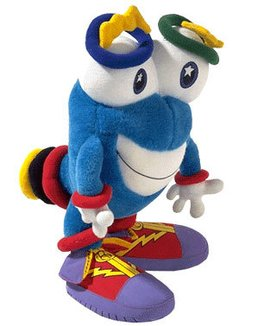
As time went by, Izzy’s appearance gradually “evolved”. The lips that were originally only there became a real mouth, and the eyes changed from the original simple shape to twinkling star patterns, which made it more vivid and expressive. And its legs also gradually became stronger and stronger from the initial thinness, which seemed to symbolize the fighting spirit of athletes. The most surprising thing was that Izzy’s face “suddenly grew a nose”, as if this technological mascot finally had “human characteristics”.
This time, Izzy is no longer just an “unknown object”, it begins to express human emotions – perhaps, it can truly represent the Olympic spirit.

Color and symbolism: the perfect fusion of technology and movement
Seeing this, you may no longer doubt the existence of Izzy. The combination of blue, sneakers, and the five rings is a perfect fusion of technology and sports. Blue symbolizes infinite possibilities and the future, while sneakers look young and energetic, as if declaring: This is what the future Olympics will look like.
The five Olympic rings are cleverly distributed in various parts of its body, perfectly blending with its appearance. Do you think its design is becoming more and more “meaningful”? Behind every little detail is the respect and embodiment of the Olympic spirit: unity, peace, and friendship, which are precisely the core values of every Olympic Games.

The meaning of Izzy: a dual symbol of innovation and the Olympic spirit
It is not difficult to find that Izzy’s existence is not only to break the tradition, but also symbolizes innovation and technology. As the first mascot created entirely by computer technology, Izzy’s design breaks through all our inherent perceptions of Olympic mascots: it is not an animal, nor a traditional character, but a perfect display of a modern technological product. Its appearance symbolizes the seamless integration of technology and sports, and demonstrates the unlimited potential of human creativity.
But at the same time, Izzy has never forgotten the Olympic spirit it carries – no matter how its appearance changes, the concepts of friendship, unity and fair competition it conveys have never changed. It may look completely different from previous mascots, but its core remains the same, still upholding the core values of the Olympics, encouraging us to transcend race and national boundaries and work together.

Izzy’s cultural impact: commercial success and subsequent influence
Izzy’s influence went far beyond the Olympic Games at the time. Its design not only broke the traditional framework of mascots, but also provided inspiration for subsequent Olympic mascot designs. As the first mascot created using computers, its innovation not only attracted a large number of audiences visually, but also promoted the digital development of mascot design.
Commercially, Izzy’s image was also a great success and became an important symbol of the Atlanta Olympics. From plush toys to clothing and stationery, Izzy appeared in almost all Olympic-related products. These products not only met the needs of Olympic fans, but also brought considerable economic benefits to the Atlanta Olympics. Its success proved that the mascot is not only a symbol, but also a powerful commercial symbol.
Conclusion: Izzy – From Doubt to Recognition
Looking back at the entire evolution of Izzy, we can’t help but sigh: the controversial “alien creature” at the beginning actually won the recognition of the whole world. Its story is a process from doubt to recognition, from confusion to success. Izzy is not only the mascot of the 1996 Atlanta Olympic Games, but also a symbol of technology and innovation, and a perfect combination of modern Olympic spirit and creativity.
This is the charm of IZZ: it allows us to see the intersection of tradition and the future, how technology can give new vitality to sports, and most importantly, it conveys the true meaning of the Olympic spirit – friendship, unity, innovation and peace.
Editorial note: This is independent cultural and historical commentary. It is not official, authorized, sponsored, endorsed by, or affiliated with the International Olympic Committee, Olympic Games organizers, teams, venues, museums, athletes, or rights holders mentioned.

Related Posts