The Dawn of Athletic Excellence: Ancient Greek Origins
The genesis of the Olympic Games is deeply intertwined with the mythological and religious tapestry of Ancient Greece. Historically recorded as beginning in 776 BC, though likely originating much earlier, these athletic contests were fundamentally religious festivals dedicated to Zeus, the king of the Greek gods. Held every four years in the sacred sanctuary of Olympia, located in the western Peloponnese peninsula, the event transcended mere physical competition. It served as a unifying cultural force for the disparate and often warring Greek city-states (poleis). The implementation of the Olympic Truce, or “Ekecheiria,” mandated a cessation of hostilities, ensuring safe passage for athletes and spectators traveling to the games. This profound integration of spirituality, diplomacy, and physical prowess laid the foundational ethos for what would eventually become a global phenomenon.
Religious Significance and the Sanctuary of Olympia
Olympia was not a city but a highly venerated sanctuary complex. At its heart stood the majestic Temple of Zeus, which housed a colossal chryselephantine (gold and ivory) statue of the deity, recognized as one of the Seven Wonders of the Ancient World. Athletes did not merely compete for personal glory; their physical exertion was viewed as an offering to the divine. Before participating, competitors were required to swear an oath before the statue of Zeus Horkios (Zeus the Keeper of Oaths), vowing to compete fairly and adhere strictly to the rules. The intertwining of religious rituals, such as hecatombs (the sacrifice of 100 oxen), with the athletic schedule underscores how the ancient Greeks equated physical perfection with moral and spiritual virtue.
To fully grasp the ancient Olympic ecosystem, one must understand the specific events that defined the era. These events were designed to test the martial skills essential for a Greek hoplite (citizen-soldier), emphasizing speed, strength, and endurance.
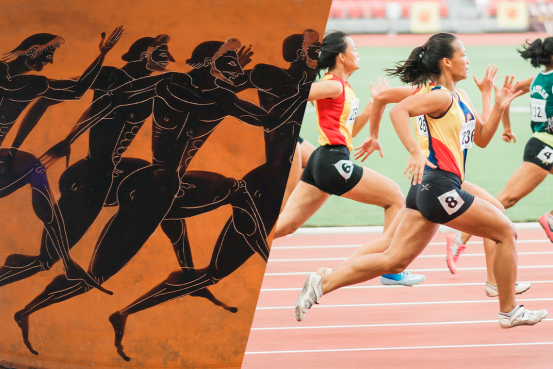
- The Stadion: The original and, for the first 13 Olympiads, the only event. It was a sprint covering the length of the Olympia track, approximately 192 meters. The winner of the Stadion was granted the ultimate honor of having the entire Olympiad named after him.
- Wrestling (Pale) and Pankration: Combat sports were brutal and highly revered. Wrestling required throwing an opponent to the ground three times, while Pankration was a grueling, virtually no-holds-barred combination of boxing and wrestling where only biting and gouging were prohibited.
- The Pentathlon: Introduced in 708 BC, this multidisciplinary event sought to identify the ultimate all-around athlete. It comprised the discus, javelin, long jump, stadion sprint, and wrestling.
- Equestrian Events: Chariot racing, particularly the four-horse tethrippon, was the most prestigious and dangerous, often sponsored by wealthy aristocrats who claimed the victory rather than the charioteers themselves.
These ancient games celebrated individual excellence (arete) over team participation. The victors received no financial compensation at Olympia; instead, they were crowned with a simple kotinos, a wreath woven from the branches of the sacred olive tree. However, upon returning to their home city-states, they were often rewarded with lifelong pensions, tax exemptions, and immortalization through poetry and sculpture.

The Dark Ages and the Revival of the Olympic Spirit
The ancient Olympic Games thrived for over a millennium, surviving the Roman conquest of Greece in the 2nd century BC. However, as the Roman Empire transitioned toward Christianity, the games’ deeply pagan roots became a point of severe ideological conflict. In 393 AD, the Christian Emperor Theodosius I issued a decree banning all pagan festivals, effectively extinguishing the Olympic flame. The sanctuary at Olympia subsequently fell into ruin, ravaged by earthquakes, floods, and barbarian invasions, burying the physical remnants of the games under meters of silt for centuries.
The Centuries of Dormancy and Early Revival Attempts
For nearly 1,500 years, the Olympic Games existed only in the realm of classical literature and historical myth. It was not until the Renaissance and the subsequent Enlightenment that Europe began to rediscover and romanticize Greco-Roman antiquity. Throughout the 17th, 18th, and early 19th centuries, various localized sporting events adopted the “Olympic” moniker. Notably, the Cotswold Olimpick Games in England (starting in 1612) and the Wenlock Olympian Games (founded by Dr. William Penny Brookes in 1850) attempted to resurrect the ancient athletic ideals. In Greece, the Zappas Olympics, funded by the wealthy philanthropist Evangelos Zappas, were held in 1859, 1870, and 1875, serving as crucial stepping stones toward a true international revival.
Pierre de Coubertin and the Vision for a Modern Games
The true architect of the modern Olympic movement was Baron Pierre de Coubertin, a French educator and historian. Motivated by a desire to reform the French educational system through physical education—inspired by the athletic programs in English public schools like Rugby—Coubertin envisioned an international sporting festival that could promote global peace and cross-cultural understanding. He believed that athletic competition could channel nationalistic rivalries into peaceful arenas.
In June 1894, Coubertin convened the historic Sorbonne Congress in Paris. Presenting his ambitious proposal to delegates from various nations, he successfully advocated for the resurrection of the Olympic Games on an international scale. The congress yielded two monumental outcomes: the unanimous decision to hold the first modern Olympics and the establishment of the International Olympic Committee (IOC), with Demetrios Vikelas of Greece elected as its first president to honor the games’ ancestral homeland.

The 1896 Athens Olympics: The Birth of the Modern Era
The selection of Athens as the host city for the inaugural modern Olympic Games in 1896 was a deeply symbolic choice, bridging the ancient past with the modern era. However, the Greek government, struggling with severe economic instability, initially balked at the immense financial burden of hosting an international event. It required a monumental fundraising effort, spearheaded by Crown Prince Constantine and heavily subsidized by wealthy Greek diaspora, most notably the Alexandrian businessman George Averoff, to make the games a reality.
Securing the Venue: The Restoration of the Panathenaic Stadium
Averoff’s most critical contribution was financing the complete restoration of the Panathenaic Stadium (Kallimarmaro). Originally built in antiquity and used for the Panathenaic Games, the stadium was excavated and entirely reconstructed using gleaming white Pentelic marble. This magnificent horseshoe-shaped arena, capable of seating 80,000 spectators, became the breathtaking centerpiece of the 1896 Games. Its unique elongated track, with extremely tight curves, posed a significant challenge to modern runners but provided a visually stunning and historically resonant theater for the athletic dramas to unfold.
Participating Nations and the Pioneer Athletes
The 1896 Athens Olympics officially opened on April 6, 1896, a date chosen to coincide with both Easter Monday and the anniversary of Greek independence. Unlike the highly structured national delegations of today, the athletes competing in 1896 were a mix of university students, independent gentlemen athletes, and tourists who happened to be in Athens at the time. There was no Olympic Village; athletes were responsible for their own travel and accommodation logistics.
To understand the scale and scope of the inaugural modern games, it is highly instructive to compare the fundamental metrics of the 1896 Athens Olympics with the ancient traditions they sought to emulate.
| Metric | Ancient Olympic Games | 1896 Modern Olympics |
|---|---|---|
| Eligibility | Freeborn Greek males only | International male athletes (approx. 14 nations) |
| Number of Athletes | Estimated in the hundreds | 241 recorded competitors |
| Number of Events | Roughly 18–20 at their peak | 43 events across 9 sports |
| Rewards | Olive wreath (Kotinos) | Silver medal & olive branch (1st), Bronze & laurel (2nd) |
| Duration | 5 days of competition/rituals | 10 days (April 6 – April 15, 1896) |
It is important to note that, adhering to the societal norms of the era and Coubertin’s own classical interpretations, female athletes were entirely excluded from competing in the 1896 Games. The 14 participating nations predominantly represented Europe and the United States, with the largest contingents coming from Greece, Germany, France, and Great Britain.

Key Events and Historic Milestones of the 1896 Games
The athletic program of the 1896 Athens Olympics featured nine sports: Athletics (track and field), Cycling, Fencing, Gymnastics, Shooting, Swimming, Tennis, Weightlifting, and Wrestling. The events were marked by a spirit of amateurism and genuine, albeit sometimes unpolished, competition. The lack of standardized international rules led to unique outcomes and fascinating historical anecdotes that remain legendary in Olympic lore.
The First Modern Olympic Champion: James Connolly
On the very first day of competition, history was made in the triple jump (then known as the “hop, step, and jump”). American athlete James B. Connolly, a Harvard University student who had essentially dropped out to travel to Athens, secured the victory. By winning this event, Connolly became the first Olympic champion in over 1,500 years. His achievement set the tone for a dominant performance by the American track and field contingent, who won 9 of the 12 athletics events despite arriving in Athens just barely in time to compete due to miscalculating the difference between the Julian and Gregorian calendars.
The Marathon: Spiridon Louis and Greek National Pride
While the Americans dominated the sprints and jumps, the emotional climax of the 1896 Games belonged entirely to the host nation. The marathon was a newly invented event, conceived by French philologist Michel Bréal specifically for the Athens Olympics. It was designed to commemorate the legendary run of Pheidippides, a Greek soldier who allegedly ran from the battlefield of Marathon to Athens in 490 BC to announce the victory over the Persians before collapsing and dying.
The 1896 marathon covered approximately 40 kilometers along the dusty roads from the town of Marathon to the Panathenaic Stadium. The race was grueling, taking a heavy toll on international favorites who were unaccustomed to the distance and the heat. In a moment of supreme national triumph, Spiridon Louis, a humble Greek water carrier, entered the stadium first. The crowd erupted into pandemonium, and Crown Prince Constantine rushed onto the track to run the final meters alongside him. Louis’s victory instantly transformed him into a national hero and provided the Greek people with a profound sense of validation and pride, cementing the modern Olympics as an event of immense cultural power.
Other notable milestones included the swimming events, which, lacking a constructed pool, were held in the freezing, open waters of the Bay of Zea. Hungarian swimmer Alfréd Hajós, who won both the 100m and 1200m freestyle, famously remarked that his sheer will to survive the frigid temperatures was greater than his desire to win.

The Legacy and Evolution Beyond 1896
The closing ceremony of the 1896 Athens Olympics was a resounding success, culminating in a royal banquet hosted by King George I of Greece. The King, bolstered by the overwhelming enthusiasm of the Greek populace, actively lobbied for Athens to become the permanent, perpetual host of all future Olympic Games. However, Pierre de Coubertin and the IOC remained steadfast in their vision of an international, rotating festival. They argued that moving the games to different global cities was essential for fostering true internationalism and preventing the event from becoming merely a Greek national holiday.
Establishing the International Olympic Committee (IOC) Authority
The decision to move the 1900 Games to Paris solidified the IOC’s authority as the supreme governing body of the Olympic movement. This transition was not without its severe growing pains. The subsequent games in Paris (1900) and St. Louis (1904) were disastrously integrated into larger World’s Fairs, resulting in disorganized scheduling, lack of public interest, and a dilution of the Olympic identity. It was not until the 1906 Intercalated Games (held again in Athens) and the highly organized 1908 London Olympics that the modern games truly stabilized and began to resemble the mega-events we recognize today.
How the 1896 Games Shaped Global Sports Diplomacy
The most enduring legacy of the 1896 Athens Olympics is the successful realization of Coubertin’s core philosophy: Olympism. Despite the modest numbers and logistical hurdles, the 1896 Games proved that athletes from rival nations could convene, compete fiercely, and coexist peacefully under a shared set of rules. This established the foundation for sports diplomacy.
- Standardization of International Sports: The necessity of competing against other nations forced the rapid development and standardization of rules across various sporting disciplines, leading to the creation of international federations.
- The Cultivation of Amateurism: The 1896 Games strictly enforced amateur rules, a principle that, while heavily debated and eventually discarded in the late 20th century, defined the ethos of the Olympic movement for over 90 years.
- Cultural Intersections: The introduction of ceremonies, the singing of anthems, and the awarding of medals created a universal language of athletic achievement that transcended linguistic and political barriers.
Ultimately, the transition from the sacred sanctuaries of Ancient Greece to the marble steps of the Panathenaic Stadium in 1896 represents one of history’s most remarkable cultural revivals. The 1896 Athens Olympics did not merely resurrect a dormant tradition; they reimagined it for a modern, interconnected world, setting into motion an athletic phenomenon that continues to captivate billions across the globe.
Frequently Asked Questions (FAQ)
- Were gold medals awarded at the 1896 Athens Olympics?
- No, gold medals were not awarded during the inaugural 1896 Games. Due to financial constraints and historical interpretations, first-place winners received a silver medal, an olive branch, and a diploma. Second-place finishers were awarded a bronze or copper medal and a laurel branch. It wasn’t until the 1904 St. Louis Olympics that the standard Gold, Silver, and Bronze medal format was introduced.
- Why were women not allowed to compete in 1896?
- The exclusion of women in 1896 was heavily influenced by the societal norms of the Victorian era and Pierre de Coubertin’s strict adherence to the ancient Greek tradition, where only men competed. Coubertin believed that female participation would be “impractical, uninteresting, unaesthetic, and incorrect.” Women eventually made their Olympic debut at the 1900 Paris Games in sports like tennis and golf.
- Did any ancient Olympic events not make it to the 1896 modern games?
- Yes, several brutal ancient events were excluded. The most notable omission was the Pankration, a violent, nearly no-rules combat sport that often resulted in severe injury or death. Additionally, chariot racing, which was the most prestigious event in antiquity, was deemed logistically impossible and too dangerous for the modern revival format.
- How did the marathon distance become 26.2 miles?
- The marathon in 1896 was approximately 40 kilometers (about 24.8 miles), based on the estimated distance from the town of Marathon to Athens. The modern standard of 26.2 miles (42.195 kilometers) was not established until the 1908 London Olympics, where the route was specifically designed to start at Windsor Castle so the royal children could watch from their nursery, and finish exactly in front of the royal box at the Olympic Stadium.
- What happened to the Panathenaic Stadium after the 1896 Games?
- The Panathenaic Stadium remains a vital historical and functional monument in Athens. It was used again for the 1906 Intercalated Games and played a significant role during the 2004 Athens Olympics, where it hosted the archery competitions and served as the iconic finish line for both the men’s and women’s marathon events.
Editorial note: This is independent cultural and historical commentary. It is not official, authorized, sponsored, endorsed by, or affiliated with the International Olympic Committee, Olympic Games organizers, teams, venues, museums, athletes, or rights holders mentioned.

Related Posts